The Brain of the Train
Mar 03, 2026
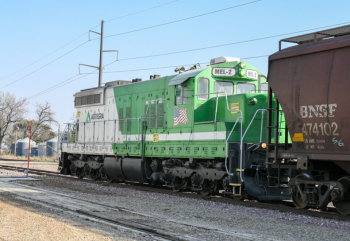
While an essential part of Agtegra’s grain business, loading trains to ship grain for export can often be viewed as a time-consuming and complex process, requiring a constant stream of communication via radio between employees for the several hours it takes to load a 110-car shuttle.
Most train loadings typically require at least four employees. One employee operates the locomotive, pulling it forward as grain is dispensed from the elevator. Another monitors the process from the control room, managing the control panel that transfers grain from the elevator into the railcars while keeping an eye on the train through the loading window. Meanwhile, two additional team members, secured with safety harnesses, walk along the tops of the railcars to open, close, and seal the lids as grain is loaded.
To ensure safety and coordination, the team relies heavily on radio communication. Adjustments are often needed—sometimes the train must inch forward or backward to align the grain spout with the car’s opening. What seems like a minor correction actually involves several radio exchanges: signaling the locomotive operator, confirming clearance from the lid crew, and getting final approval from the control room. This back-and-forth happens every time the train shifts, adding to the overall loading time. And when radio signals lag or drop, the delay not only slows the process—it poses safety risks.
Enter the locomotive remote control.
Designed to enhance efficiency and safety of train loading processes, the remote control system has two main pieces of equipment – a box that is placed on the lead locomotive and the remote itself. The remote can do anything that the control panel of the locomotive can do – from brakes to horns, it becomes the new “brain” of the train.
The remote can operate 3,500+ feet from the locomotive, which allows it to be operated from the control room where the operator is loading grain. Now, instead of having to radio back and forth with the locomotive operator to move the train, the operator can do so with the remote and line up the grain spout seamlessly, right from the loading window. This greatly enhances speed and efficiency in loading trains.
Agtegra owns three of these remotes, which rotate between its grain locations depending on train loading schedules. The Mellette location has been using a remote control for two years now and has seen an increase in efficiency because of its use.
“Our team is able to be much more accurate when loading because we aren’t relying on a person a radio call away to move the train. Instead of grabbing for a radio and the inevitable delay in movement, it’s the push of a button now, right from the loading window,” Mellete Grain Manager Jonathan Knight said.
Safety is always a priority at Agtegra, and that’s especially true when team members are working atop railcars to open and close lids. With remote and elevator operations located next to the train loading platform, the operator has a clear view to ensure both team members are ready before the train moves. The remote system also includes horns and other audible signals that provide safety alerts and operational cues, helping communicate locomotive status and operator actions to the crew on top of the railcars.
“The remote’s horns and buzzers make it much easier to communicate with the guys who are on top of the railcars. They can hear it easily, which helps keep them safe when communicating what the operator’s next move is,” Jonathan said.
At locations where the locomotive may cross a road during loading, Agtegra continues to prioritize public safety. Team members place train crossing barricades to alert traffic, and the remote operator still sounds the horn when approaching certain crossings—just as was done when an operator was physically inside the locomotive. To reassure passersby, signage is displayed on the locomotive indicating it’s being operated remotely. In Mellette, cameras mounted on buildings along the track provide the remote operator with a clear view of the locomotive’s movement, ensuring safe and efficient operation throughout the process.
Some may worry that automating a process like the locomotive operation removes the need for people. However, someone still must operate the remote, and the person who used to sit in the locomotive for several hours at a time can now work in other areas of the facility during this time.
“We operate in a challenging environment for sourcing talent; engaging automation allows us to focus on our employees' development and enhance Agtegra operations, creating strong business continuity for our member-owners,” Agtegra Chief Operating Officer Mike Rizor said.
Innovative technologies are paving the way for increased automation across the industry. While human involvement remains essential, these advancements offer safer and more efficient ways for employees to perform their tasks. Companies have started introducing technologies such as autonomous railcar loading, which includes systems capable of opening, closing, and sealing railcars automatically. Beyond train loading, grain elevator functions like operating grain dryers can be managed remotely from miles away. This allows on-site staff to concentrate on supporting farmers, while others focus on monitoring and managing equipment from a distance.
“Staying with the leading edge of technology is a critical focus for Agtegra; we can integrate these new advancements in our people and processes to increase our effectiveness,” Mike said.
Most train loadings typically require at least four employees. One employee operates the locomotive, pulling it forward as grain is dispensed from the elevator. Another monitors the process from the control room, managing the control panel that transfers grain from the elevator into the railcars while keeping an eye on the train through the loading window. Meanwhile, two additional team members, secured with safety harnesses, walk along the tops of the railcars to open, close, and seal the lids as grain is loaded.
To ensure safety and coordination, the team relies heavily on radio communication. Adjustments are often needed—sometimes the train must inch forward or backward to align the grain spout with the car’s opening. What seems like a minor correction actually involves several radio exchanges: signaling the locomotive operator, confirming clearance from the lid crew, and getting final approval from the control room. This back-and-forth happens every time the train shifts, adding to the overall loading time. And when radio signals lag or drop, the delay not only slows the process—it poses safety risks.
Enter the locomotive remote control.
Designed to enhance efficiency and safety of train loading processes, the remote control system has two main pieces of equipment – a box that is placed on the lead locomotive and the remote itself. The remote can do anything that the control panel of the locomotive can do – from brakes to horns, it becomes the new “brain” of the train.
The remote can operate 3,500+ feet from the locomotive, which allows it to be operated from the control room where the operator is loading grain. Now, instead of having to radio back and forth with the locomotive operator to move the train, the operator can do so with the remote and line up the grain spout seamlessly, right from the loading window. This greatly enhances speed and efficiency in loading trains.
Agtegra owns three of these remotes, which rotate between its grain locations depending on train loading schedules. The Mellette location has been using a remote control for two years now and has seen an increase in efficiency because of its use.
“Our team is able to be much more accurate when loading because we aren’t relying on a person a radio call away to move the train. Instead of grabbing for a radio and the inevitable delay in movement, it’s the push of a button now, right from the loading window,” Mellete Grain Manager Jonathan Knight said.
Safety is always a priority at Agtegra, and that’s especially true when team members are working atop railcars to open and close lids. With remote and elevator operations located next to the train loading platform, the operator has a clear view to ensure both team members are ready before the train moves. The remote system also includes horns and other audible signals that provide safety alerts and operational cues, helping communicate locomotive status and operator actions to the crew on top of the railcars.
“The remote’s horns and buzzers make it much easier to communicate with the guys who are on top of the railcars. They can hear it easily, which helps keep them safe when communicating what the operator’s next move is,” Jonathan said.
At locations where the locomotive may cross a road during loading, Agtegra continues to prioritize public safety. Team members place train crossing barricades to alert traffic, and the remote operator still sounds the horn when approaching certain crossings—just as was done when an operator was physically inside the locomotive. To reassure passersby, signage is displayed on the locomotive indicating it’s being operated remotely. In Mellette, cameras mounted on buildings along the track provide the remote operator with a clear view of the locomotive’s movement, ensuring safe and efficient operation throughout the process.
Some may worry that automating a process like the locomotive operation removes the need for people. However, someone still must operate the remote, and the person who used to sit in the locomotive for several hours at a time can now work in other areas of the facility during this time.
“We operate in a challenging environment for sourcing talent; engaging automation allows us to focus on our employees' development and enhance Agtegra operations, creating strong business continuity for our member-owners,” Agtegra Chief Operating Officer Mike Rizor said.
Innovative technologies are paving the way for increased automation across the industry. While human involvement remains essential, these advancements offer safer and more efficient ways for employees to perform their tasks. Companies have started introducing technologies such as autonomous railcar loading, which includes systems capable of opening, closing, and sealing railcars automatically. Beyond train loading, grain elevator functions like operating grain dryers can be managed remotely from miles away. This allows on-site staff to concentrate on supporting farmers, while others focus on monitoring and managing equipment from a distance.
“Staying with the leading edge of technology is a critical focus for Agtegra; we can integrate these new advancements in our people and processes to increase our effectiveness,” Mike said.